What Is a LiFePO4 Battery?
LiFePO4 (lithium iron phosphate) batteries utilize iron phosphate as a cathode material instead of the more common cobalt or nickel. They have an exceptionally long cycle life (3,000–6,000+), excellent thermal and chemical stability, and can deliver consistent power – making them the preferred chemistry for most portable power stations, home solar battery storage, and recreational vehicle systems today.
How a LiFePO4 battery works
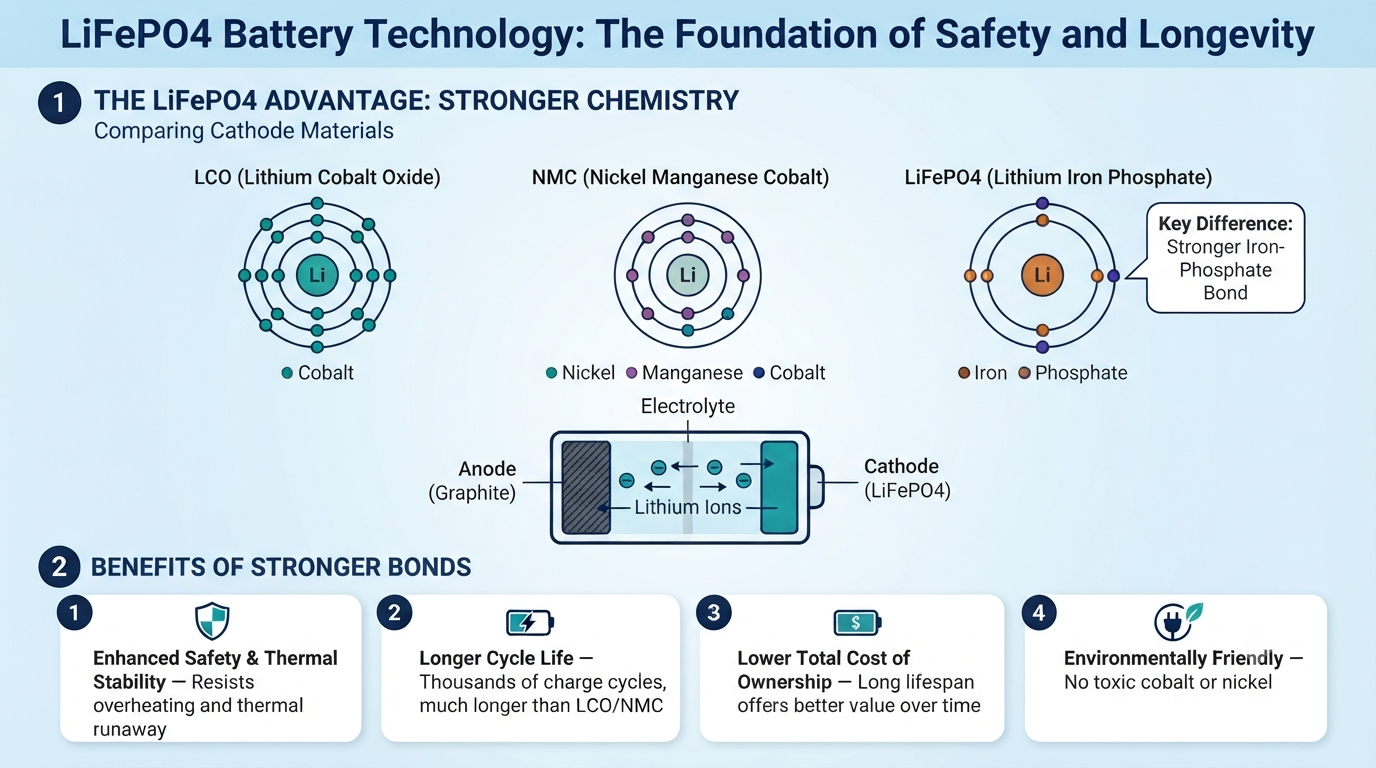
Like any lithium-ion battery, a LiFePO4 cell stores energy by transferring lithium ions between two electrodes – positive (cathode) and negative (anode) – with the help of an electrolyte. The critical difference lies in the chemistry of the cathode, where lithium phosphate replaces lithium cobalt oxide or nickel manganese cobalt – the common choice in consumer electronics and many other power stations.
The bonds in lithium-iron phosphate are fundamentally stronger and more stable than their cobalt or nickel counterparts – and that difference makes all the difference. This subtle change in electrochemistry is the reason behind almost all of LiFePO4 batteries’ touted benefits.
Key advantages of LiFePO4
- Long cycle life — a rated 3,000-6,000+ full discharges at 80% DoD (depth of discharge), compared to 500-1,200 for lead-acid and roughly 500-1500 for standard lithium-ion (NMC).
- Thermal and chemical stability — LiFePO4 is far less likely to suffer from thermal runaway reactions (which cause catastrophic battery venting) than NMC or LCO lithium batteries, due to the stability of its cathode under high pressure or heat.
- Flat discharge curve — LiFePO4 maintains a relatively stable voltage delivery throughout discharge, providing consistent power output until nearly depleted.
- No cobalt — unlike many competing lithium battery technologies, LiFePO4 does not contain cobalt, a toxic, often unethical source of metal.
- Wide usable capacity — can be discharged up to 80-100% of its rated capacity with minimal performance loss, compared to only 50% for legacy lead-acid batteries.
Trade-offs to know
-
Lower energy density (by weight) compared to lithium-ion NMC batteries, which means that for equivalent watt-hours, a LiFePO4 battery will weigh more and be larger in size.
-
Charging at cold temperatures (below 0 °C or 32 °F) requires special care to avoid damaging the cells. It is best to charge the battery at warm temperatures (around room temperature). However, discharging a lithium iron phosphate battery at low temperatures is not a problem.
-
The nominal voltage of LiFePO4 batteries is lower than that of lithium-ion batteries, which means that fewer cells in series are needed to reach the desired voltage. The nominal voltage of LiFePO4 cells is about 3.2 V, compared to 3.6-3.7 V for NMC cells.
LiFePO4 vs. other battery chemistries
| Chemistry | Cycle life | Energy density | Thermal stability | Common use |
|---|---|---|---|---|
| LiFePO4 | 3,000–6,000+ | Medium | High | Power stations, solar, RV, marine |
| NMC (Li-ion) | 500–1,500 | High | Moderate | Laptops, EVs, some power stations |
| Lead-acid (AGM) | 300–800 | Low | High | Cars, older backup systems |
| Sodium-ion | 2,000–4,000+ | Low–Medium | High | Emerging in power stations, cold-climate use |
What LiFePO4 batteries are used for
LifePO4 is used in many sectors because of its long life span and security.
- In portable power stations, almost all of them (that I have reviewed on this site) use this type of battery. These are usually power stations that have a lithium battery as their main component.
- This chemistry is also used in home solar storage batteries, which are often paired with solar panels to store electricity for daily use.
- It is also used in RVs, campers and boats as an alternative to lead-acid house batteries. The advantage over lead-acid batteries is obvious: higher capacity and much lower weight.
And finally, LifePO4 batteries are used in electric cars, in particular in entry-level models (such as the Renault Zoe), where the specific energy is not so important.
Frequently asked questions
Is LiFePO4 the same as lithium-ion?
LiFePO4 is one type of lithium battery made with lithium iron phosphate as a cathode. Unlike the NMC or LCO batteries that are more common for lithium-ion cells, LiFePO4 has better thermal stability and a longer cycle life, but it also has a higher weight per unit of energy.
How long do LiFePO4 batteries last?
Most LiFePO4 batteries can be charged and discharged 3,000 to 6,000 times at 80%DOD before losing over 80% of their capacity. With regular use, this means 8 to 15 years of lifespan.
Are LiFePO4 batteries safe?
Yes. The chemistry of LiFePO4 batteries is regarded as the safest among the popular lithium battery types. The reason is that the material of its positive electrode is thermally stable and does not release oxygen when heated, which makes it quite difficult to undergo thermal runaway, unlike NMC and LCO lithium batteries.
What is the downside of LiFePO4 batteries?
Compared to other lithium technologies, LiFePO4 batteries provide lower energy density, implying that for the same amount of stored energy, they will be heavier and bulkier. Moreover, their low-temperature performance is inadequate, and they should not be charged below freezing points without a heating element.
Can I use a regular charger on a LiFePO4 battery?
No. LiFePO4 batteries require a charger or charge profile that follows the specific voltage curve of the battery (3.2V per cell). A lead-acid or generic Li-ion charger will not fully charge the battery or may damage it.